

Suspension tuning tips for optimized performance 2026
Suspension tuning separates average handling from exceptional control. Whether you’re chasing lap times on track or improving daily driver comfort, getting your suspension dialed in demands understanding dampers, springs, tire pressure, and geometry. This guide walks you through expert criteria and actionable tips to optimize your setup for any driving scenario, helping you balance performance with real-world usability.
Table of Contents
- 1. Understanding Damper Adjustments: Balancing Compression And Rebound
- 2. Selecting Spring Rates For Your Driving Conditions
- 3. Tire Pressure And Its Impact On Grip And Ride Comfort
- 4. Advanced Technologies: Active Suspension And Optimization Methods
- 5. Impact Of Chassis Geometry Modifications On Suspension Performance
Key takeaways
| Point | Details | |-------|---------|| | Damper balance | Compression and rebound adjustments directly control cornering stability and ride quality. | | Spring rate selection | Matching spring stiffness to terrain and use case prevents compromised performance. | | Tire pressure synergy | Proper inflation works with suspension settings to maximize grip and comfort. | | Active technologies | Modern control algorithms like ESC and AO deliver measurable ride quality improvements. | | Geometry modifications | Lowering and widening alter camber, toe, and roll centers, requiring recalibration. |
1. Understanding damper adjustments: balancing compression and rebound
Dampers control how quickly your suspension compresses and extends. Compression damping resists the shock absorber compressing when hitting bumps, while rebound damping controls how fast it extends back. Getting this balance right is non-negotiable for handling. Proper damper adjustment is crucial for enhancing vehicle handling during cornering, where weight transfer can make or break lap times.
Vehicle weight distribution plays a huge role here. Heavier cars need stiffer compression to prevent bottoming out, while lighter vehicles benefit from softer settings that maintain tire contact. Your driving style matters equally. Aggressive cornering demands firmer rebound to prevent excessive body roll, but too stiff kills mechanical grip on uneven surfaces.
Start with manufacturer baseline settings, then adjust in small increments. Too much compression damping makes the ride harsh and reduces traction over bumps. Insufficient rebound lets the suspension bounce excessively, unsettling the chassis mid-corner. The sweet spot keeps tires planted while allowing the suspension to work through surface irregularities.
Critical damper tuning considerations:
- Test one end at a time: front adjustments affect turn-in, rear changes impact rotation
- Increase compression for high-speed stability, decrease for small bump compliance
- Add rebound damping to control body roll, reduce it if the car feels skittish
- Match settings to track conditions: smooth surfaces tolerate stiffer setups
Pro Tip: Log your changes and track conditions in a notebook. Suspension memory is terrible, and data reveals patterns you’d otherwise miss. After three track days with detailed notes, you’ll spot trends that shortcut future tuning sessions.
2. Selecting spring rates for your driving conditions
Spring rate determines how much force is needed to compress your suspension one inch. This single specification shapes ride quality, body control, and how your car responds to weight transfer. The physics of crawling versus racing differ fundamentally, making choosing a single spring setup for both applications ineffective.
Soft springs excel in low-speed scenarios where maintaining tire contact over obstacles matters most. Off-road crawling benefits from compliant springs that let wheels articulate independently, keeping rubber on rocks. Conversely, track driving demands stiffer springs to minimize body roll and maintain precise geometry through high-speed corners. The trade-off is harsh: soft springs improve comfort but allow excessive lean, while stiff springs enhance control at the expense of small bump absorption.
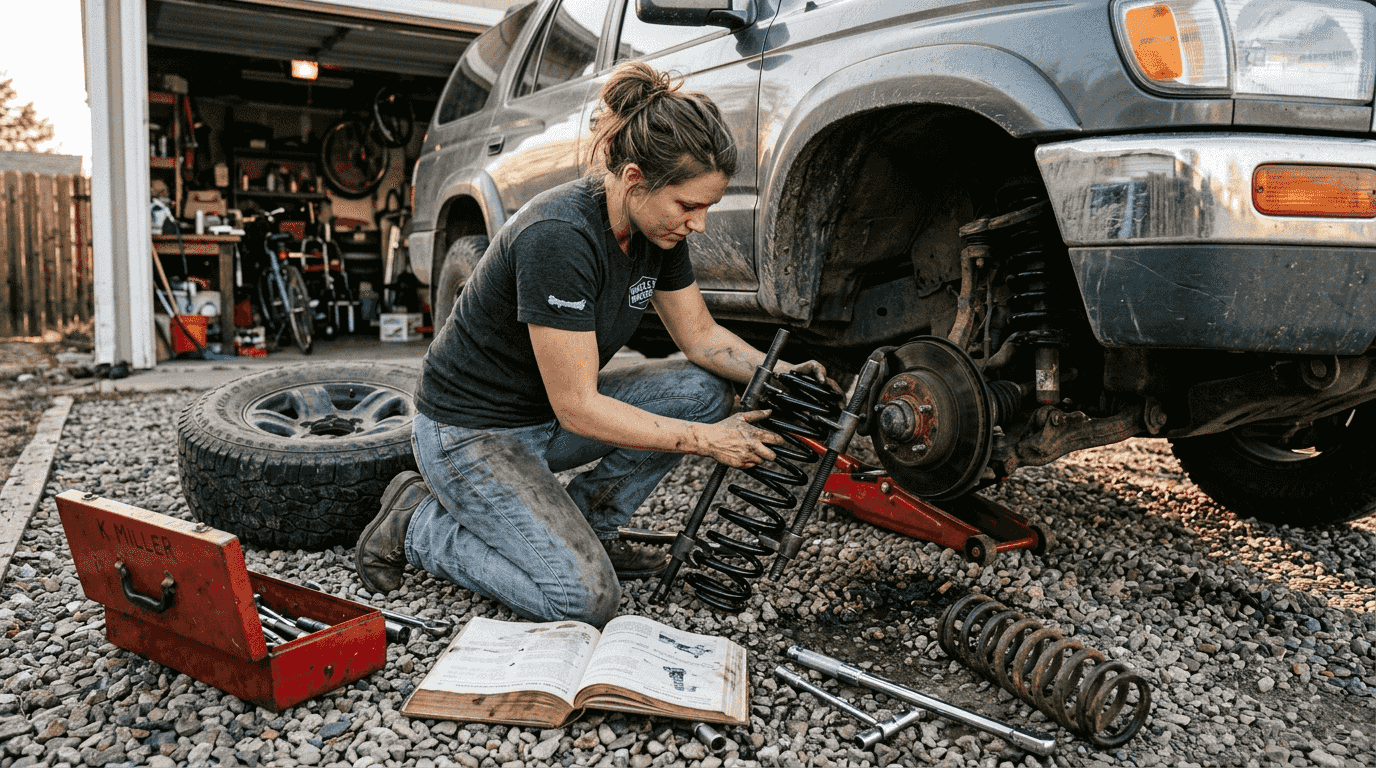
Common mistakes include blindly copying spring rates from similar builds without considering weight distribution or intended use. A 500 lb/in front spring might work perfectly on a 2,800 lb track car but turn a 3,400 lb street car into a bucking bronco. Calculate corner weights, then select rates that maintain ride height under load while preventing excessive compression.
Spring rate selection framework:
- Street comfort: softer rates (200 to 350 lb/in front) for compliance over potholes
- Track performance: stiffer rates (400 to 800 lb/in front) for minimal body roll
- Off-road: very soft rates (under 200 lb/in) for articulation and traction
- Drift applications: balanced rates that allow controlled weight transfer
Match front to rear spring rates based on weight distribution. A 60/40 front-biased car needs proportionally stiffer front springs to prevent nose dive under braking. Test incrementally, as going too stiff immediately highlights every pavement imperfection and fatigues drivers quickly.
3. Tire pressure and its impact on grip and ride comfort
Tire pressure acts as the final suspension component, directly affecting contact patch shape and size. Properly inflated tires contribute significantly to both ride comfort and grip, yet most enthusiasts overlook this easily adjustable parameter. Pressure changes how your suspension communicates road feel and how effectively tires generate lateral grip.
Over-inflation creates a smaller, rounded contact patch that reduces grip and transmits every road imperfection harshly into the cabin. The tire’s center wears faster, and handling becomes twitchy as the reduced footprint struggles to generate cornering force. Under-inflation produces the opposite problem: excessive sidewall flex generates heat, increases rolling resistance, and causes premature edge wear. The larger contact patch might seem beneficial, but the tire’s structure can’t support proper load transfer.
Ideal pressure depends on tire construction, vehicle weight, and application. Street driving typically runs 32 to 36 psi cold for most performance tires, while track use often requires 36 to 42 psi hot to compensate for heat buildup. Measure pressure cold before driving, then check again after heat cycles to understand your tire’s behavior.
Pressure tuning for different scenarios:
- Daily driving: manufacturer recommended pressures for balanced wear and comfort
- Track days: increase 4 to 6 psi over street pressures to handle heat
- Autocross: experiment with 2 psi variations to tune turn-in response
- Off-road: drop to 15 to 20 psi for increased footprint and traction
Pro Tip: Invest in a quality digital tire gauge and check pressures weekly. Temperature swings cause 1 to 2 psi variations per 10 degrees Fahrenheit, so seasonal adjustments maintain consistency. Keep a log linking pressures to handling characteristics for quick reference.
4. Advanced technologies: active suspension and optimization methods
Modern suspension designs incorporate advanced technologies such as semi-active and fully active damping systems that adjust in real time. These systems monitor vehicle dynamics through accelerometers and adjust damping forces milliseconds before traditional setups react. The performance gap between passive and active systems continues widening as control algorithms improve.
Semi-active systems adjust damping within fixed limits using magnetorheological or electronic valves, offering 70 to 80% of fully active performance at lower cost and complexity. Fully active systems add hydraulic actuators that can push or pull, essentially making suspension work as an anti-roll system. Control strategies determine how effectively these systems respond. Proportional-Integral-Derivative (PID) controllers form the foundation, with variants like Fractional Order PID (FOPID) offering enhanced tuning flexibility.
Optimization algorithms dramatically improve controller performance. The ESC algorithm achieved the lowest ITAE value in controlling half-car active suspension, outperforming Aquila Optimizer (AO) and Sand Cat Swarm Optimization (SCSO) methods. These algorithms fine-tune controller parameters automatically, achieving ride quality improvements manual tuning can’t match.
Active suspension control comparison:
| Algorithm | ITAE Performance | Convergence Speed | Practical Application |
|---|---|---|---|
| ESC | Lowest values | Fast | High-end sports cars |
| AO | Moderate | Medium | Mid-range performance |
| SCSO | Higher | Variable | Cost-sensitive systems |
| Traditional PID | Baseline | N/A | Standard implementations |
Implementation costs remain the primary barrier. Fully active systems add $5,000 to $15,000 to vehicle cost, while semi-active options run $2,000 to $6,000. For dedicated track cars or high-end builds, the investment delivers measurable lap time improvements and dramatically enhanced ride quality across varying conditions.
5. Impact of chassis geometry modifications on suspension performance
Physical modifications like lowering ride height and increasing track width impact suspension parameters such as camber, toe, and roll center height. These changes aren’t merely aesthetic; they fundamentally alter suspension kinematics and require comprehensive retuning to maintain handling balance. Many builds fail because enthusiasts modify geometry without addressing downstream effects.
Lowering reduces center of gravity and improves aerodynamics, but it raises roll center relative to the center of gravity, potentially increasing jacking forces that lift the inside tire during cornering. Camber curves change dramatically, often adding negative camber that improves cornering grip but accelerates tire wear. Bump steer increases as tie rod angles deviate from ideal, causing steering changes over bumps that unsettle the chassis.
Widening track width through spacers or wider wheels increases the tire scrub radius and alters steering feel. The suspension sees changed lever arms that affect spring and damper rates effectively. These modifications demand alignment adjustments and often require revised spring and damper settings to compensate for altered geometry.
Geometry modification effects:
| Modification | Camber Change | Toe Impact | Roll Center | Bump Steer |
|---|---|---|---|---|
| Lower 1.5 inches | +0.5 to 1° negative | Minimal if aligned | Rises 0.3 to 0.5 inches | Increases moderately |
| Wider track 20mm | Negligible | Toe-out tendency | Moves outboard slightly | Minimal change |
| Combination | +1 to 1.5° negative | Requires adjustment | Complex interaction | Significant increase |
Post-modification tuning checklist:
- Perform four-wheel alignment immediately after geometry changes
- Reassess spring rates as altered geometry changes effective wheel rate
- Test bump steer on alignment rack and add correction if needed
- Adjust damping to compensate for changed suspension velocities
Successful geometry modifications require understanding the interconnected nature of suspension parameters. Change one variable and three others shift in response. Professional corner balancing and alignment after modifications isn’t optional, it’s the difference between improved handling and a car that fights you through every turn.
Explore high-quality suspension components at NordRace
Optimizing suspension performance demands precision components that maintain geometry under load. Quality bushings and mounts form the foundation of responsive handling, eliminating compliance that dilutes your tuning efforts.
NordRace offers reinforced strut mount bushes engineered for Honda applications, eliminating deflection that compromises damper effectiveness. Pair these with reinforced stabilizer links for Honda and Subaru platforms to maintain anti-roll bar geometry during aggressive cornering. Complete your rebuild with Honda Civic arm bushings that restore precise suspension kinematics.
Pro Tip: Replace all suspension bushings simultaneously when upgrading components. Mixing worn and new bushings creates inconsistent compliance that makes tuning impossible to dial in properly.
Suspension tuning tips FAQs
How often should I adjust dampers for different track conditions?
Adjust dampers whenever track surface or weather conditions change significantly. Smooth, warm tracks tolerate stiffer settings, while cold or bumpy surfaces need softer damping for mechanical grip. Start each track day with baseline settings, then make small adjustments based on tire temperatures and driver feedback.
Can I use the same spring rates for street and off-road driving?
No, street and off-road applications require fundamentally different spring rates due to distinct load scenarios and terrain. Street springs prioritize body control and comfort over smooth pavement, while off-road springs need extreme compliance for articulation. Dual-use vehicles benefit from adjustable coilovers that allow spring swaps between applications.
What is the best tire pressure for balanced performance?
Balanced performance typically occurs between 34 and 38 psi cold for most performance street tires, varying by tire construction and vehicle weight. Start at manufacturer recommendations, then adjust in 1 psi increments while monitoring tire temperatures across the tread. Even temperatures indicate optimal pressure.
Are active suspension systems worth the investment?
Active suspension delivers measurable improvements in ride quality and handling, but cost versus benefit depends on your use case. Dedicated track cars and high-end street builds justify the $5,000 to $15,000 investment through enhanced performance and adaptability. Weekend warriors get better value from quality passive setups and proper tuning.
How does lowering ride height affect suspension geometry?
Lowering raises the roll center relative to the center of gravity, potentially increasing body roll despite the lower stance. It also adds negative camber, increases bump steer, and changes suspension travel characteristics. Any ride height change beyond 1 inch requires professional alignment and often benefits from adjustable control arms to restore proper geometry.
Recommended
- Hardrace - tugevdatud TPV ülemise ja alumise amortisaatori puks Honda – NordRace OÜ
- Hardrace - eesmine tugevdatud stabilisaatorivarras TPV Honda, Subaru – NordRace OÜ
- Hardrace - Tagumise stabilisaatori puks Honda Civic, Integra – NordRace OÜ
- Hardrace - Esimese ja alumise õõtshoova puks - Amort Tesla Model 3, Mo – NordRace OÜ